

Act No. 2026-534 of 25 June 2026 on combating social security and tax fraud has tightened the penalties applicable to employers in relation to the Single Document for the Assessment of Occupational Risks (DUERP).
Mandatory from the moment the first employee is taken on, the DUERP is an essential document for the prevention of occupational risks and the protection of your employees’ health and safety.
We therefore provide a summary of the main applicable rules, as well as the penalties now incurred :
DUERP : Principles and regulatory framework
The purpose of the DUERP is to identify, assess and prioritise the risks to which your employees may be exposed in the course of their work, in order to put in place the necessary preventive measures to safeguard their health and safety.
The assessment must cover all occupational risks to which employees are exposed (falls, manual handling, hazardous substances, stress, etc.), taking particular account of the nature of the work carried out, workstations, exposure conditions and the organisation of work.
It must then enable the definition of the preventive and protective measures to be implemented to eliminate these risks or, failing that, to reduce them.
The DUERP is therefore a genuine prevention tool.
It must reflect the reality of your business and be updated regularly to keep pace with changes in your operations and the risks to which your employees are exposed.
In companies with at least 11 employees, the DUERP must be updated at least once a year.
Regardless of the size of the company, it must also be updated whenever there is a significant change affecting health, safety or working conditions, or when a new risk is identified.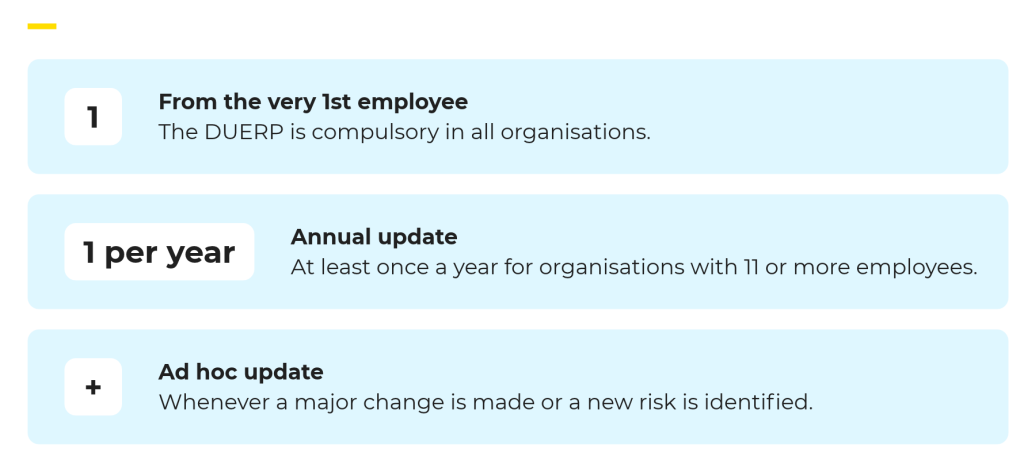
New penalties for failure to submit a DUERP
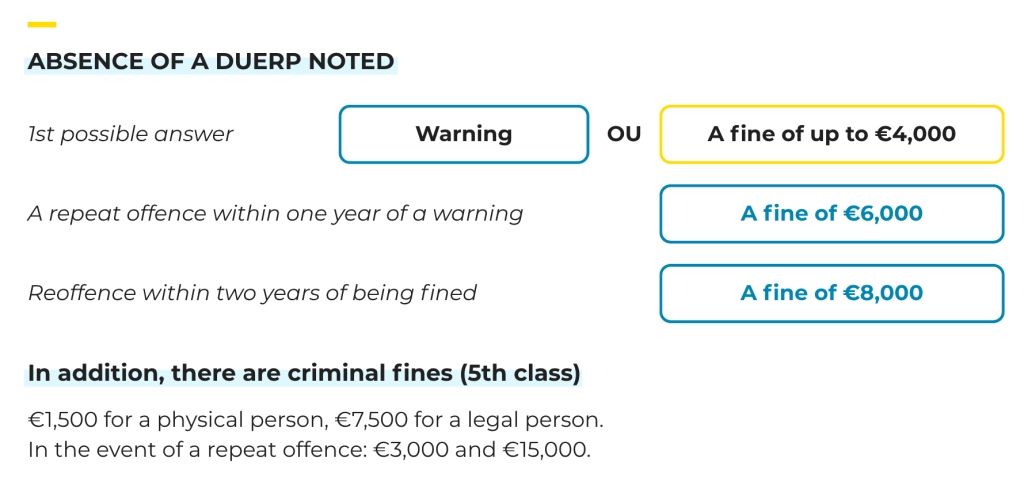
Since 27 June 2026, failure to submit a DUERP may now result in an administrative penalty imposed directly by the labour inspectorate without the need for court proceedings.
The non-compliant employer may therefore be subject to :
- A warning;
- Or an administrative fine of up to €4,000 per employee concerned.
The amount of the fine may be increased to €8,000 per employee concerned in the event of a further breach detected within two years of notification of a previous fine, and to €6,000 per employee concerned in the event of a further breach detected within one year of notification of a warning.
These new administrative penalties are in addition to the criminal penalties that already existed in relation to the DUERP, namely the fine applicable to fifth-class offences, which may amount to :
- €1,500 for a natural person;
- €7,500 for a legal person.
In the event of a repeat offence, these amounts may be increased to €3,000 and €15,000 respectively.
The risks associated with workplace accidents or occupational illnesses
Apart from administrative and criminal penalties, the absence or inadequacy of the DUERP can have serious consequences in the event of an accident at work or an occupational illness.
The DUERP is, in fact, a central element of the employer’s prevention strategy.
In the event of a workplace accident or occupational illness, the absence of a DUERP or an inadequate risk assessment may be used against the employer in a dispute concerning their duty of care and, depending on the circumstances, in proceedings seeking to establish their inexcusable fault.
→ Under criminal law, a negligent employer may be ordered to pay a fine of up to €75,000, in addition to a prison sentence of five years (in the event of an employee’s death).
→ In civil law, a finding of inexcusable fault on the part of the employer entails an obligation on the employer’s part to pay compensation for the losses suffered by the employee as a result of an accident at work or an occupational disease. This compensation takes the form of :
- An increase in the pension (or lump-sum payment) payable in respect of the work-related accident or occupational illness;
- Additional damages to compensate for all the harm suffered by the employee (physical and mental suffering, disfigurement and loss of enjoyment of life);
- As well as reimbursement to the Primary Health Insurance Fund of the benefits paid to the employee.
The financial consequences for the company can therefore be particularly severe in the event of a claim.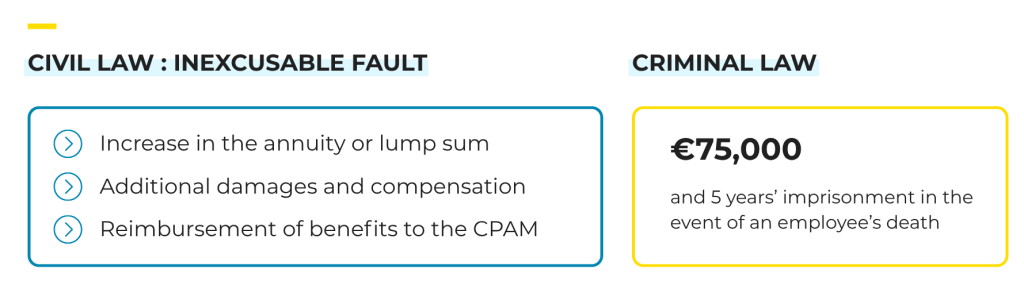
We are available to discuss this with you and to assist you in drawing up or updating your DUERP.
Do you have any questions ? Your dedicated account manager is on hand to answer any questions you may have.
This article was written in October 2026 by the Social Department